Pokémon fusion is exactly what it sounds like. You take two Pokémon, splice them into one creature, and end up with something that has the head of one and the body of the other. A Charizard head on a Blastoise body. A Pikachu face on a Snorlax frame. It has been one of the most popular corners of Pokémon fan culture for over a decade now, and if you have ever typed pokemon fusion into a search box you already know how deep the rabbit hole goes.
This post covers where fusions came from, how the sprites are actually generated, the difference between a fusion generator and a fusion game, and how to play ours. It is free, it runs in the browser, and there is nothing to download.
Where Pokémon fusion came from
The idea goes back to fan art and forum threads, but it went properly mainstream around 2013 with the Pokémon Fusion generator, a small web toy that let you pick a head and a body from the original 151 and spat out a merged sprite. It was crude by modern standards. It just stitched the top half of one sprite onto the bottom half of another. That was enough. People shared the ugliest results for years.
The next big step was Pokémon Infinite Fusion, a fan project that took the concept seriously. Instead of a rough splice, it uses hand-drawn and auto-generated sprites for an enormous number of head and body combinations, with fused typings, fused stats, and fused movepools. That is why searches like pokemon infinite fusion, infinite fusion calculator, and pokemon fusion generator all pull huge numbers. The community built a whole game out of a joke.
It is worth being clear about the categories, because people looking for fusions usually want one of three different things. A fusion generator makes you a sprite from two Pokémon you choose. A fusion calculator tells you what the resulting typing, stats, and abilities would be. A fusion game asks you to do something with the fusion. Ours is the third kind.
How a fusion sprite is actually built
Every fusion has a head donor and a body donor, and the split is not a straight horizontal cut. The head donor gives you the face, the ears, the horns, the mouth, and the general read of the creature's expression. The body donor gives you the frame, the limbs, the tail, and, importantly, the colour palette.
That palette swap is the part that makes fusions fun and also the part that makes them hard to identify. A green Charizard head is still a Charizard head. The green is telling you about the other half of the answer. Once you internalise that, you stop getting fooled by colour and start reading silhouettes instead.
Autogenerated fusion sprites work by mapping the two source sprites onto a shared template, which is why some combinations look surprisingly clean and others look like a crime. Both outcomes are part of the appeal.
Play Guess the Fusion
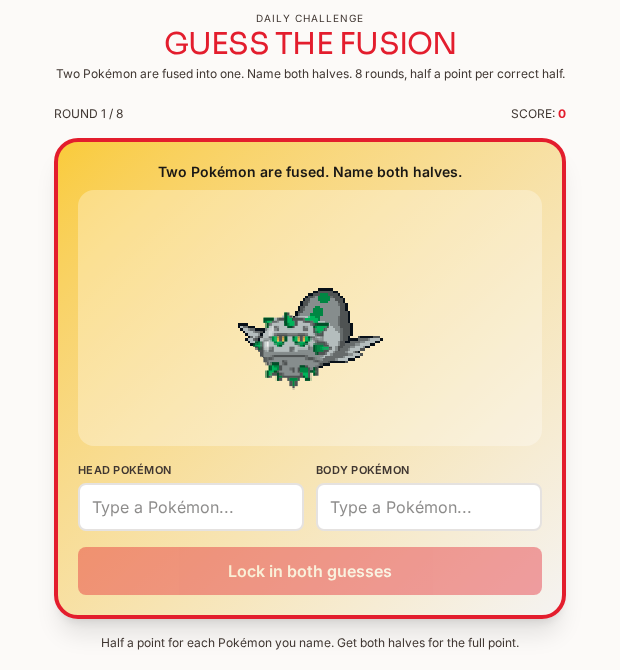
Our take flips the generator on its head. Instead of you picking two Pokémon and seeing the result, we show you the result and you name the two Pokémon that went into it. Eight rounds per run, one fused sprite per round, two answer boxes with autocomplete: head and body.
Scoring uses partial credit. Half a point for the head, half a point for the body, so a perfect round is one point and a perfect run is eight. If you only recognise one half you still score, which keeps the hard rounds worth attempting instead of worth skipping.
There is a daily run that is identical for every player, so you can compare scores with a friend on the exact same eight fusions, and an unlimited mode if you want to keep going after the daily is done. The fusion set spans 420 Pokémon across Generations 1 through 7, so it is not just Kanto favourites.
Tips for guessing fusions
Solve the head first. Faces are what your memory actually stores, and identifying the head immediately narrows what the body can plausibly be. Working body-first is much harder because a recoloured body shape can belong to a dozen species.
Ignore colour on your first pass. The palette belongs to the body, so treat it as a clue about the second answer and not the first.
Hunt for hard features a fusion cannot smooth away: wings, a single horn, a shell, a flame or bulb, a tail with an unusual shape. One of those cuts the candidate pool down to a handful. The genuinely brutal rounds are the round, limbless, featureless bodies, and those are where your remaining thinking time should go.
Type colouring is a legitimate signal too. A body that has gone blue and finned is a Water Pokémon even if you cannot name it yet. And since partial credit exists, lock in the half you are sure about rather than holding the whole round hostage to a perfect answer.
Do you need to download anything?
No. A lot of the traffic around fusions is people trying to figure out how to install a fan game, get it running on a phone, or patch it onto something. That is a real hobby and plenty of people enjoy it, but it is not what this is. Guess the Fusion runs in any browser on desktop and mobile, no install, no account, no patching.
If you want the full rules, the scoring breakdown, and a longer strategy write-up, we keep a dedicated fusion guide on the site. If you just want to play, the button above drops you straight into today's run.